You can go a lot of places using Avenida Juan Ponce de León in San Juan, particularly if you’re an out-of-town basketball writer covering a Christmas season multi-team event in town, and desperate to see as much of the place as possible without getting lost.
The usual starting point, in my case, was the Somos Hotel in the Santurce barrio, which does everything it can to lean into the presence of a modern art museum on the next block. One of Café Don Juan’s 11 outposts sits two buildings over from the art museum, along with its gigantic chorizo and bacon omelets. From there, it’s about a mile and a half down the road to the Sagrado Corazón station on the single rail line in the city.
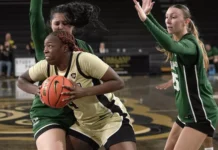
That line – like all public transit, completely free for most of the last two years, though that’s coming to an end on New Year’s Day – lumbers past 13 stops before arriving at a stop called “Deportivo,” overlooking the Coliseo Rubén Rodríguez. The 12,000-seat arena primarily serves as the home of the Vaqueros de Bayamón, the most successful team in the island’s professional league, though it’s also seen four Cleveland State wins over the last two Decembers while hosting the Puerto Rico Clasico.
The opposite direction on Avenida Juan Ponce de León will lead you over a bridge spanning the Laguna del Condado, past the territory’s capitol, and right up to the cruise terminal and the edge of Viejo San Juan. That’s where you’ll find Ponce de León himself; his tomb is located inside the Catedral de San Juan Bautista (Saint John the Baptist, the city’s namesake).
I found myself thinking about the conquistador a lot in San Juan. Even in realms settled for hundreds or thousands of years, solo travel has a way of bringing out your inner explorer. After all, you’re all you’ve got, so it’s tempting to throw on your headphones and play some sweeping music, or act like the main character in some hero’s journey biopic while you order a pizza. That scene where you went outside three separate times after midnight to stare at a bus stop sign, while trying to figure out which side of Avenida Juan Ponce de León you’d need to wait on the next day? On the cutting room floor, hopefully.
Buses and trains are convenient for long distances, but most of the best scouting is done on two feet.
San Juan is an incredibly human place. Walk around for an hour or two, and it’s hard not to notice its many contradictions. Burned-out, graffitied ruins right next to shimmering high rises. Financiers headed to work in Hato Rey while a rooster crows in someone’s front yard nearby. Roberto Clemente murals overlooking basketball courts. English and its uneasy co-existence with Spanish, perhaps the most visible battle in a larger war for the soul of Puerto Rico. A smiling tour guide on a vehicle flying past a wall with “gringos go home” written on it.
Even as a white guy from Ohio who only knows enough Spanish to say “gracias” at the end of an interaction (or “lo siento, no hablo español” when approached on the street), it’s hard to avoid feeling a connection to the city. Ultimately, it’s taking things day by day and trying its best to keep moving forward, as we all are.
Most probably associate Ponce de León with a futile search for the Fountain of Youth, even though he never mentioned such a quest in any of his writings. He was only roped to the legend posthumously by biographers with flawed information, ulterior motives, or both. His fateful visits to Florida probably had a lot more to do with gold and the expansion of the Spanish empire.
After all, that’s why he ended up on Christopher Columbus’ second voyage to the New World, and what eventually brought him to Puerto Rico. Why would Florida be any different?


Still, it’s awfully tempting to wonder: Why him? Of all the people hanging around the Caribbean during the early 16th century, how did Ponce de León end up reduced to “the Fountain of Youth guy” in the history books?
After helping Nicolás de Ovando conquer the island of Hispaniola (including the subjugation and enslavement of the native Taíno people, which should be mentioned in any retelling of his story), Ponce de León received permission from Ovando and King Ferdinand II to move on to Puerto Rico in 1508. His first couple of expeditions began on the western end of the island, but he eventually settled just outside of modern-day San Juan. After finding tons of gold, to the delight of all involved, Ponce de León was installed as Puerto Rico’s first governor in 1509.
It was hardly smooth sailing from there. Ovando returned to Spain shortly afterwards, and Columbus’ eldest son, Diego Colón, asserted that he should inherit his father’s titles and privileges, which were quite sweeping (Columbus’ “discovery” of the Western Hemisphere had produced a substantial overreaction in that regard). After winning in court, Colón became Viceroy of Hispaniola and immediately began circumventing Puerto Rico’s governor, who was under his oversight.
The two would go back and forth in a mostly-peaceful battle for the island for the next couple years, but Ponce de León gave up in 1511.
By that point, the explorer was in his late 30s, on the precipice of middle-age malaise, and certainly weary from his power struggle with Colón. He had been driven out of the office that he may have considered the culmination of his life’s work, and his faithful service to both the king and Ovando. Is it so crazy to suggest that he might have been interested in the Fountain of Youth, which would present an opportunity to try everything over again?
Back in Spain, a sympathetic Ferdinand II suggested he search for Bimini, in the modern-day Bahamas, where native legend placed the mythical fountain. Ponce de León could become governor of anything he found, the king said, which would serve the dual purpose of keeping the disloyal Colón in check.
Instead, he ended up “discovering” Florida, assumed to be an island at the time, and was greeted with a hero’s welcome on his return to Spain. He was knighted, given a personal coat of arms, and had his right to govern Puerto Rico reinstated.
Though certainly happy with those honors, and the ability to return to his adopted home, Florida was never far from Ponce de León’s mind. He eventually left his governorship for the final time in 1519, and organized another expedition to that prohibitively large island. That time, however, he was hit in the thigh with an arrow during a skirmish with the Calusa people, and taken to Cuba, where he died of a likely infection.
If only he had a mid-major basketball team to follow.
There’s something about walking around San Juan that causes me to consider my life, and rather bizarre place in the Cleveland State ecosystem, in a way that driving to Dayton and back in one night simply can’t.
I’m not entirely sure why that is. The money? I tried my best to get through everything on the cheap; I aggressively shopped for flights and rode in Dirtbag Class, and the Somos Hotel was some distance from the towering resorts along the beach, both literally and figuratively. Even with those concessions, getting to and staying in San Juan cost around a thousand dollars, quite an expense in service of a couple game recaps and this column.
It could be the cavernous, mostly-empty arena. Looking around during either of CSU’s games, it was hard to avoid the fact that everyone else supporting the Vikings in the audience of a couple dozen was a member of the team’s traveling party. The grand “oh yeah, I’ll definitely go” declarations of boosters at the school’s season-launching fundraising soirée back in August, it turned out, were just that.


Being a category of one can be awkward at times, particularly when trying to explain myself to others – a common occurrence around the holidays.
“So you’re with Cleveland State?”
“Well, no, I’m not with Cleveland State, though they do appreciate my presence. I’m just some guy who obsessively follows them everywhere and writes stuff on the internet.”
“Oh, like a reporter?”
“I guess, though most reporters get paid. Nobody pays me, I just do it to, uh…anyway, what’s wrong with those Cavaliers?”
Reducing things to numbers and labels is a flawed way of approaching it though. After all, this is nothing less than my own quest for the Fountain of Youth.
Not in any literal sense, obviously, as myths are myths. Still, there’s that inescapable notion that college sports programs are perpetual sources of youthful energy. Even as each individual ages, the roster collectively doesn’t.
That much was driven home on December 20th, when the Vikings went on an arduous excursion to El Yunque National Forest. Two players, Colby Maples and Queen Ruffin, demanded to be full participants despite their respective leg injuries, to the exasperation of Chris Kielsmeier.
“What are we doing with two injured players here?” the coach remembered thinking. “But they were adamant. I’m seeing that water. I’m seeing those slides.’ We got them to a certain point. We thought it was close enough, and they were like, ‘I didn’t come this far not to see the water and all the full experience. I’m going the whole way.’”
Would Maples and Ruffin make the same decision, with the same risks, at 50 years old and burdened by the ever-growing fears and responsibilities of aging? For that matter, would I?
Every trip, whether to Puerto Rico, Southern California, or Youngstown, is a conscious decision and, as each approaches, I need to deliberately renew my efforts. When I get set to hit the road, I wonder if I’m finally about to concede to adulthood, alongside most others. Maybe I’m at the point where I should sit on my couch and binge Columbo again, instead of on the edge of sanity in an airport all night. If nothing else, I should probably accept that I’ve given this writing thing my best shot and have gotten all I can from it.
Or maybe I should push aside my worst thoughts, wriggle out of rationality’s vice grip, and keep chasing for one more day. As long I’m willing to keep going, I’m still young, even as my linear age marches forward.
In the final minute of play on December 19th, Izabella Zingaro knocked down a three-pointer in the final minute of play. The shot clinched a win over College of Charleston, a top-100 NET team, CSU’s biggest victory of the year by just about any measure.
Somewhere above the lower bowl of the Coliseo Rubén Rodríguez, in the heart of Bayamón, Puerto Rico, nobody was watching as I violated journalistic decorum by jumping to my two feet and pumping my left fist, while letting out a “ALRIGHT!” that hopefully wasn’t heard on the broadcast.
It was one more win in a long season, and a longer lifetime.
Subscribe to our emails, and get our latest posts in your inbox, plus a weekly digest of everything we've published!