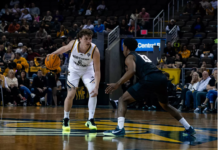
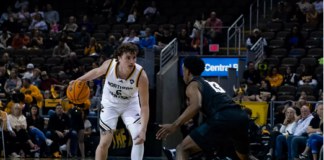
Izabella Zingaro won her first-ever Horizon League Player of the Week nod on Monday, after helping the Vikings to what was fairly objectively their best seven day run of the season, including victories over Green Bay and Robert Morris.
For her part, the graduate student averaged 18.5 points and 10.5 rebounds over the pair of contests, though the overtime stunner against the Phoenix last Wednesday was probably her best work. That evening, she drew a staggering 11 fouls and went 14-for-16 from the free throw line, on the way to 23 tallies.
“I’m definitely really lucky to be in a system where post play is valued,” Zingaro said during the team’s weekly radio show on Monday. “I mean, I’ve got teammates that are able to give me the ball and it makes my life a lot easier. I get all these opportunities because I have some really good playmakers.”
The Montana transfer posted two double-doubles in her first 22 games of the season, but has dramatically picked up her rebounding of late, and now has an active streak of six consecutive such outings.
On the show, she was asked whether scoring or rebounding was harder, and showed that she might become a triple-double threat if jokes are ever treated as a basketball statistic.
“I think rebounding is probably a little bit harder, because you rebound and then it goes up by one rebound at a time,” Zingaro deadpanned, in her best Taurean Prince impression. “Scoring, other than free throws, it’s two points.”
“They’re both pretty hard to do, just with the physicality and stuff down there,” she added, in a late attempt to offer a serious answer.
Her recent hot streak has opened the door to an even bigger prize: the HL’s Player of the Year award. Cleveland State has dominated that honor recently, with Destiny Leo, Colbi Maples, and Mickayla Perdue claiming it at the end of the last three years.
Could Zingaro make it four in a row?
Purdue Fort Wayne’s Alana Nelson and Green Bay’s Jenna Guyer are widely considered the two frontrunners right now, but CSU’s candidate has as good of a case as either of them. In conference play, Zingaro is the Horizon League’s leading scorer (17.9 points per game) and second-leading rebounder (8.4 per game, behind Detroit Mercy’s Jasmine Edwards). Across all games, she is a close second to Nelson in scoring, and number four in rebounding (trailing Edwards, Milwaukee’s Jorey Buwalda, and Youngstown State’s Sophia Gregory).
She also remains among the top 20 players nationally in field goal percentage, as well as free throws made and attempted. And – oh yeah – she outplayed both Nelson and Guyer in recent head-to-head meetings, thanks largely to her underrated defensive work.
“I really enjoy playing zone, and I love this zone,” Zingaro said. “I think it’s very great when you’re able to execute it properly. Everybody has a big role in the zone no matter where you’re on the floor. As a five, I definitely have a lot of responsibility, anybody that comes into the key, but it is really fun.”
Perhaps the biggest obstacle for Zingaro’s Player of the Year candidacy is team performance. Cleveland State presently sits in fifth place, but in the 39-year history of the award, just six winners have come from teams that finished lower than third in the final standings, and only three played for schools that wound up beneath fourth place.
Additionally, the most recent player in both of those tallies, Macee Williams, of the institution then known as IUPUI, deserves a massive asterisk. Her Jaguars ended 2020-21 with the best winning percentage in the Horizon League, yet only in fifth place, thanks to a bizarre formula used by the conference office that season that, essentially, punished teams for COVID-19 related cancellations.
If nothing else, there is at least a little bit of historical precedent on CSU’s side. Former Viking Audra Cook was named the 1999-2000 HL Player of the Year, despite her team’s sixth-place record.
Persistence Pays Off
Late in her segment, Zingaro discussed her recruitment to Cleveland State, which followed what’s become a familiar pattern in the transfer portal era. Specifically, a coach and a school might end up chasing a player through three or even four recruiting cycles before finally landing them.
That was certainly the case with Zingaro, as Chris Kielsmeier tried his best with the 6-4 center out of high school. However, she began her college career at Iowa State, then rebuffed Kielsmeier a second time to play at Montana in 2024-25, after leaving the Cyclones.
All’s well that ends well, though.
“Since being here, me and my family joke about all the time, I definitely should have come here [first],” Zingaro said. “I’ve had so much fun here and it’s been a great opportunity, and I’ve probably been in my happiest over college. So if I could go back [and do things differently], I would, definitely.”
“I’ve known her and her family for a long, long time and nothing she is doing surprises me now,” Kielsmeier offered. “If I would’ve had the chance to coach her earlier, it wouldn’t have surprised me back then either.”
Quality, Not Quantity
One of the more difficult tasks for Vikings observers all season, but particularly in recent weeks, has been quantifying Paula Pique’s role on the team.
Conventional stats aren’t really a ton of help. The sophomore averages 3.5 points per game, despite playing 22.7 minutes, which results in some absurdly-low per-40 numbers across most offensive categories. Her rebounding (3.0), assists (1.7), and steals (1.3) numbers range from passable to very good, but still seem to fall short of the big picture.
What, exactly, is that big picture? In the Vikings three recent impressive wins – Purdue Fort Wayne, Green Bay, and Robert Morris – Pique has played 30, 32, and 35 minutes, and it’s impossible to ignore the correlation between her time on the floor and CSU’s fortunes. Often, her plus-minus rating will match, or even exceed, more heralded players like Zingaro and Maples.
Yet it’s nearly impossible to explain how or why that happens, without loads of coaching experience and the intimate basketball knowledge that comes with it. Fortunately, Kielsmeier has those things, and he’s willing to help.
“Paula is the glue of our team,” he began, before acknowledging the issue. “Nothing necessarily speaks volumes on the stat sheet every night as to what she’s doing, compared to what she actually does.”
Pique did her best to make it easier for the rest of us with important run-stopping three-pointers against the Phoenix and Colonials. Ultimately though, most of her impact happens on the other end of the floor, and thanks largely to her rapidly-growing comfort level with Cleveland State’s zone.
“I love to pressure the ball,” she said. “With our zone, that allows me to do it a lot, and I love to read the passes and everything and get a lot of deflections or steals. I think I’m pretty good at it, and I react [quickly] when something happens, and that allows me to make the read and anticipate everything.”
The Barcelona native’s individual defensive rating (points allowed per 100 possessions faced) is 84.3, among the top 20 percent of players in the country.
Speed Run
Cleveland State clinched its sixth 20-win season since 2019-20 by beating RMU on Saturday. Kielsmeier, after spending some time passing credit for the accomplishment to those around him, said that for him, not all successful seasons are created equal.
“This one’s different for me personally,” he admitted. “I know what it was like in those offices when people were leaving, and people had told us they were coming back, and then they changed and made decisions that were best for them, and their future, and their families. I respect all of that.”
Kielsmeier, of course, was referring to the nine Vikings who entered the transfer portal in the aftermath of their defeat at Buffalo in last year’s WNIT Fab Four. One of the nine, Perdue, initially announced her return on social media, then reversed course a couple days later and committed to Arizona.
Given that CSU’s 2024-25 season didn’t end until the first week of April thanks to the deep postseason run, those departures created quite a time crunch, and Kielsmeier didn’t have his new roster finalized until June.
“That’s the norm these days,” he said. “For us to have the roster that we had in April, and for us to [win 20 games again] speaks so much about our coaching staff identifying the right kind of people. Notice I said the right kind of people, because this program and how we go about doing things is not for everybody.”
“Everybody says they want success until they realize what success means, and then some of ’em may back off of it, but not these kids. That’s not how our program goes about doing things, and it’s pretty dang special what we’ve done.”
Subscribe to our emails, and get our latest posts in your inbox, plus a weekly digest of everything we've published!